

09-16-2024, 02:23 AM
(This post was last modified: 10-08-2025, 11:12 PM by Hugh Wallington.)
A personal account of forming a chord
As I see it, there are three main ways you can play a chord you see written on a piece of music. Each of these gives you the notes to play to form the chord .. which can be played in any order. These are called Inversions of the chord.
So C – E – G (with the fifth note of the scale on top); E – G – C (with the root on top); G – C – E (with the third note of the scale on top) are all the C chord.
A.
For the many chords that appear on your sheet music you can look up the notes to play to make up the chord. There are "Chord Charts" that show every chord you could possibly want. A computerised Chord Analyser is even better as you can click with the mouse and actively take part in your search. And you have one of these hidden away on your keyboard! This is where Yamaha have their ‘CHORD TUTOR’.
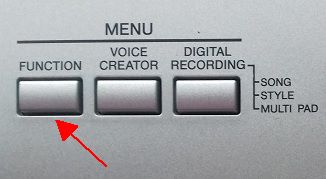
Press FUNCTION ...
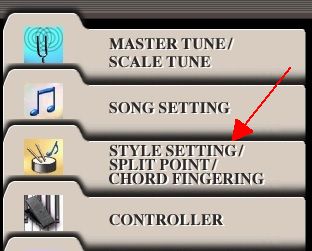
... then STYLE SETTING.
Tab across to the page CHORD FINGERING ...
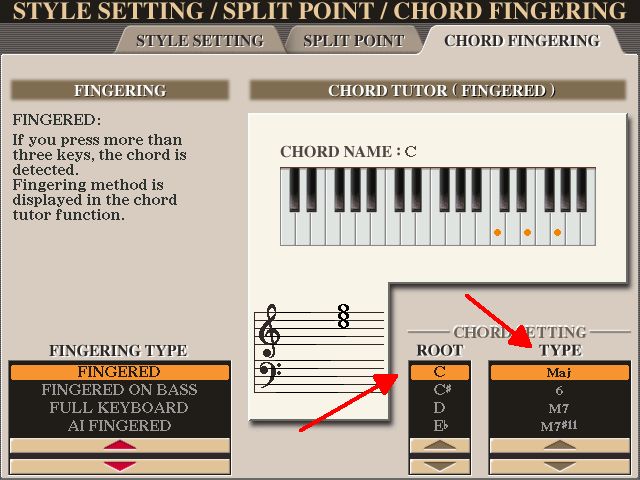
... and there you have it. Move down/up underneath either column to get the various chords showing.
On the 'touch screen' keyboards (eg. Genos; PSR-SX700 etc.) these Chord Types can be found here.
Thanks to James for sending me these screenshots of his Genos 2.
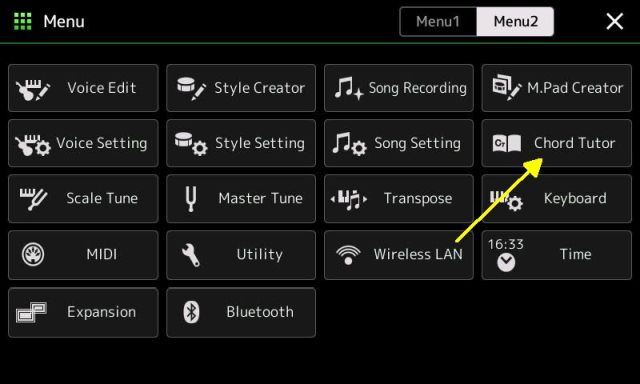
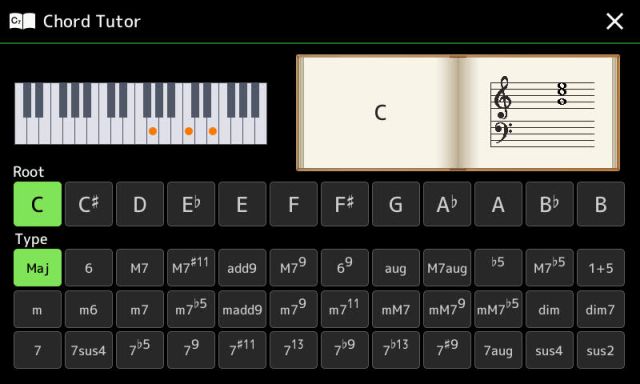
Although there are loads of chords listed in the Genos 2 screenshot above, for most music there are about ten chords that they may use. I am not talking here about the variety of chords that you may see in a piece, but the chords that can be formed on one particular note. Eg. On C , you could have:
C MAJOR ( C )
C MINOR ( Cm )
C SIXTH ( C6 )
C MINOR SIXTH ( Cm6 )
C SEVENTH ( C7 )
C MAJOR 7th ( Cmaj7 )
C AUGMENTED (Caug .. often written as C+ )
C DIMINISHED ( Cdim .. sometimes written as Co )
C SUSPENDED 4th ( Csus4 )
C NINTH ( C9 )
As there are seven white notes and five black ones, in total there are twelve notes you could form a chord on. So the total number of chords available for a piece of music is 12 x 10 = 120 (in addition to others that are less common). Now you could commit all these chords to memory, or remember the most frequently used ones depending on the key the piece is played in, but to my way of thinking there is no logic in this as there is no indication as to how these chords are formed in the first place. So no thanks, you won't catch me going down this road!
B.
Next, how the chords are formed from "scales". For this method you would have to know the notes in each scale. Twelve possible notes to start on, so twelve scales to learn. Mind you, each scale is based on "intervals", so you can work a scale out if you don't already know it.
I'm sure we all know what a "scale" is in Tonic Sol-fa. If not from our school days, then from Julie Andrews teaching the children how to sing in The Sound Of Music. "You start at the very beginning .. a very good place to start" .. with Doh. The notes in a scale are doh, ray, me, fah, soh, lah, te, doh (the top 'doh' being one octave above the first). And there are other names for the sharps and flats .. but don't ask me what they are!
So starting on any note you play the "scale" doh, ray, me, fah, soh, lah, te (I haven't gone right to the end) and from this point on will use numbers to donate the position on the scale. So doh=1, ray=2, me=3, fah=4, soh=5, lah=6 and te=7.
Another way to form a scale is by "intervals", and I use this terminology as this is the basis for Method C. I shall define an interval as one semitone "up" (ie. the next note up, whether it be white or black). The "intervals" for a scale, starting on any note, are as follows:
Root (base note .. the one you are starting with) then (in intervals) 2, 2, 1, 2, 2, 2, 1.
So starting with C, the "Scale" (doh, ray, me, fah, soh, lah, te, do) .. working it out using the "intervals" above .. is C, D, E, F, G, A, B (and then on to "top C" with the final interval of 1). Now we all know the scale of C, I'm sure .. but you could use this method for working out the notes in the scale of, say, F#.
The idea now is just to use the numbers to represent the scale rather than the tonic sol-fa names. So the scale becomes 1, 2, 3, 4, 5, 6, 7, x (x being note 8, but being the octave above 1 and having the same letter as 1 it will not be referred to as 8. It is 1 again!).
The chords are described using the numbers in the scale. Which is why I said you would have to know your scales to use this method.
So, in C , 1=C, 2=D, 3=E, 4=F, 5=G, 6=A and 7=B.
A MAJOR chord is 1 - 3 - 5 (ie. doh – me – soh)
C MAJOR ( C ) is C - E - G
A MINOR chord is 1 - 3 (flatted) - 5
C MINOR ( Cm ) is C - Eb – G
A SIXTH chord is 1 - 3 - 5 - 6
C SIXTH ( C6 ) is C - E - G - A
A MINOR SIXTH chord is 1 - 3 (flatted) - 5 - 6
C MINOR SIXTH( Cm6 ) is C - Eb - G - A
A SEVENTH chord is 1 - 3 - 5 - 7 (flatted)
C SEVENTH ( C7 ) is C - E - G - Bb
A MAJOR SEVENTH chord is 1 - 3 - 5 - 7
C MAJOR SEVENTH ( Cmaj7 ) is C - E - G - B
An AUGMENTED chord is 1 - 3 - 5 (sharpened)
C AUGMENTED ( C+ ) is C - E - G#
A DIMINISHED chord is 1 - 3 (flatted) - 4 (sharpened) - 6
C DIMINISHED ( Cdim ) is C - Eb - F# - A
A SUSPENDED 4th chord is 1 - 4 - 5
C SUSPENDED 4th ( Csus4 ) is C - F - G
A NINTH chord is 1 - 2 - 3 - 5 -7 (flatted)
C NINTH ( C9 ) is C - D - E - G - Bb
Now having written all this out it looks so complicated I think I’ll go back to method A ! Seriously though, if you do know your scales then the “numbers” mentioned above become second nature and it is a fairly simple process to work out the chord from scratch.
C.
The third way is by starting with any note (I shall call this the Root of the chord) you form the chord using “intervals” from one note to the next, an “interval” being defined as one semitone "up" (ie. the next note up, whether it be white or black). The "intervals" for the various chords are:
A MAJOR chord is Root + 4 + 3
C MAJOR ( C ) is C - E - G
A MINOR chord is Root + 3 + 4
C MINOR ( Cm ) is C - Eb - G
A SIXTH chord is Root + 4 + 3 + 2
C SIXTH ( C6 ) is C - E - G - A
A MINOR SIXTH chord is Root + 3 + 4 + 2
C MINOR SIXTH( Cm6 ) is C - Eb - G - A
A SEVENTH chord is Root + 4 + 3 + 3
C SEVENTH ( C7 ) is C - E - G - Bb
A MAJOR SEVENTH chord is Root + 4 + 3 + 4
C MAJOR SEVENTH ( Cmaj7 ) is C - E - G - B
An AUGMENTED chord is Root + 4 + 4
C AUGMENTED ( C+ ) is C - E - G#
A DIMINISHED chord is Root + 3 + 3 + 3
C DIMINISHED ( Cdim ) is C - Eb - F# - A
A SUSPENDED 4th chord is Root + 5 + 2
C SUSPENDED 4th ( Csus4 ) is C - F - G
A NINTH chord is the SEVENTH chord with the note Root + 2 added.
C NINTH ( C9 ) is C - D - E - G - Bb
Doing it this way you don't have to know any of the notes forming a 'scale'.
One or two videos I have seen on YouTube count all the intervals from the Root.
I prefer counting up from one note to the next in ‘intervals’.
If you would like to download this document/print it out, you can do so from this BOX LINK.
https://app.box.com/s/hf04y4aju5nqpy0c4ofu87uuaxuyfz2m
Hugh
As I see it, there are three main ways you can play a chord you see written on a piece of music. Each of these gives you the notes to play to form the chord .. which can be played in any order. These are called Inversions of the chord.
So C – E – G (with the fifth note of the scale on top); E – G – C (with the root on top); G – C – E (with the third note of the scale on top) are all the C chord.
A.
For the many chords that appear on your sheet music you can look up the notes to play to make up the chord. There are "Chord Charts" that show every chord you could possibly want. A computerised Chord Analyser is even better as you can click with the mouse and actively take part in your search. And you have one of these hidden away on your keyboard! This is where Yamaha have their ‘CHORD TUTOR’.
Press FUNCTION ...
... then STYLE SETTING.
Tab across to the page CHORD FINGERING ...
... and there you have it. Move down/up underneath either column to get the various chords showing.
On the 'touch screen' keyboards (eg. Genos; PSR-SX700 etc.) these Chord Types can be found here.
Thanks to James for sending me these screenshots of his Genos 2.
Although there are loads of chords listed in the Genos 2 screenshot above, for most music there are about ten chords that they may use. I am not talking here about the variety of chords that you may see in a piece, but the chords that can be formed on one particular note. Eg. On C , you could have:
C MAJOR ( C )
C MINOR ( Cm )
C SIXTH ( C6 )
C MINOR SIXTH ( Cm6 )
C SEVENTH ( C7 )
C MAJOR 7th ( Cmaj7 )
C AUGMENTED (Caug .. often written as C+ )
C DIMINISHED ( Cdim .. sometimes written as Co )
C SUSPENDED 4th ( Csus4 )
C NINTH ( C9 )
As there are seven white notes and five black ones, in total there are twelve notes you could form a chord on. So the total number of chords available for a piece of music is 12 x 10 = 120 (in addition to others that are less common). Now you could commit all these chords to memory, or remember the most frequently used ones depending on the key the piece is played in, but to my way of thinking there is no logic in this as there is no indication as to how these chords are formed in the first place. So no thanks, you won't catch me going down this road!
B.
Next, how the chords are formed from "scales". For this method you would have to know the notes in each scale. Twelve possible notes to start on, so twelve scales to learn. Mind you, each scale is based on "intervals", so you can work a scale out if you don't already know it.
I'm sure we all know what a "scale" is in Tonic Sol-fa. If not from our school days, then from Julie Andrews teaching the children how to sing in The Sound Of Music. "You start at the very beginning .. a very good place to start" .. with Doh. The notes in a scale are doh, ray, me, fah, soh, lah, te, doh (the top 'doh' being one octave above the first). And there are other names for the sharps and flats .. but don't ask me what they are!
So starting on any note you play the "scale" doh, ray, me, fah, soh, lah, te (I haven't gone right to the end) and from this point on will use numbers to donate the position on the scale. So doh=1, ray=2, me=3, fah=4, soh=5, lah=6 and te=7.
Another way to form a scale is by "intervals", and I use this terminology as this is the basis for Method C. I shall define an interval as one semitone "up" (ie. the next note up, whether it be white or black). The "intervals" for a scale, starting on any note, are as follows:
Root (base note .. the one you are starting with) then (in intervals) 2, 2, 1, 2, 2, 2, 1.
So starting with C, the "Scale" (doh, ray, me, fah, soh, lah, te, do) .. working it out using the "intervals" above .. is C, D, E, F, G, A, B (and then on to "top C" with the final interval of 1). Now we all know the scale of C, I'm sure .. but you could use this method for working out the notes in the scale of, say, F#.
The idea now is just to use the numbers to represent the scale rather than the tonic sol-fa names. So the scale becomes 1, 2, 3, 4, 5, 6, 7, x (x being note 8, but being the octave above 1 and having the same letter as 1 it will not be referred to as 8. It is 1 again!).
The chords are described using the numbers in the scale. Which is why I said you would have to know your scales to use this method.
So, in C , 1=C, 2=D, 3=E, 4=F, 5=G, 6=A and 7=B.
A MAJOR chord is 1 - 3 - 5 (ie. doh – me – soh)
C MAJOR ( C ) is C - E - G
A MINOR chord is 1 - 3 (flatted) - 5
C MINOR ( Cm ) is C - Eb – G
A SIXTH chord is 1 - 3 - 5 - 6
C SIXTH ( C6 ) is C - E - G - A
A MINOR SIXTH chord is 1 - 3 (flatted) - 5 - 6
C MINOR SIXTH( Cm6 ) is C - Eb - G - A
A SEVENTH chord is 1 - 3 - 5 - 7 (flatted)
C SEVENTH ( C7 ) is C - E - G - Bb
A MAJOR SEVENTH chord is 1 - 3 - 5 - 7
C MAJOR SEVENTH ( Cmaj7 ) is C - E - G - B
An AUGMENTED chord is 1 - 3 - 5 (sharpened)
C AUGMENTED ( C+ ) is C - E - G#
A DIMINISHED chord is 1 - 3 (flatted) - 4 (sharpened) - 6
C DIMINISHED ( Cdim ) is C - Eb - F# - A
A SUSPENDED 4th chord is 1 - 4 - 5
C SUSPENDED 4th ( Csus4 ) is C - F - G
A NINTH chord is 1 - 2 - 3 - 5 -7 (flatted)
C NINTH ( C9 ) is C - D - E - G - Bb
Now having written all this out it looks so complicated I think I’ll go back to method A ! Seriously though, if you do know your scales then the “numbers” mentioned above become second nature and it is a fairly simple process to work out the chord from scratch.
C.
The third way is by starting with any note (I shall call this the Root of the chord) you form the chord using “intervals” from one note to the next, an “interval” being defined as one semitone "up" (ie. the next note up, whether it be white or black). The "intervals" for the various chords are:
A MAJOR chord is Root + 4 + 3
C MAJOR ( C ) is C - E - G
A MINOR chord is Root + 3 + 4
C MINOR ( Cm ) is C - Eb - G
A SIXTH chord is Root + 4 + 3 + 2
C SIXTH ( C6 ) is C - E - G - A
A MINOR SIXTH chord is Root + 3 + 4 + 2
C MINOR SIXTH( Cm6 ) is C - Eb - G - A
A SEVENTH chord is Root + 4 + 3 + 3
C SEVENTH ( C7 ) is C - E - G - Bb
A MAJOR SEVENTH chord is Root + 4 + 3 + 4
C MAJOR SEVENTH ( Cmaj7 ) is C - E - G - B
An AUGMENTED chord is Root + 4 + 4
C AUGMENTED ( C+ ) is C - E - G#
A DIMINISHED chord is Root + 3 + 3 + 3
C DIMINISHED ( Cdim ) is C - Eb - F# - A
A SUSPENDED 4th chord is Root + 5 + 2
C SUSPENDED 4th ( Csus4 ) is C - F - G
A NINTH chord is the SEVENTH chord with the note Root + 2 added.
C NINTH ( C9 ) is C - D - E - G - Bb
Doing it this way you don't have to know any of the notes forming a 'scale'.
One or two videos I have seen on YouTube count all the intervals from the Root.
I prefer counting up from one note to the next in ‘intervals’.
If you would like to download this document/print it out, you can do so from this BOX LINK.
https://app.box.com/s/hf04y4aju5nqpy0c4ofu87uuaxuyfz2m
Hugh
It's all about the music!
![[-]](https://chellos-keyboard-players-club.com/images/collapse.png)
